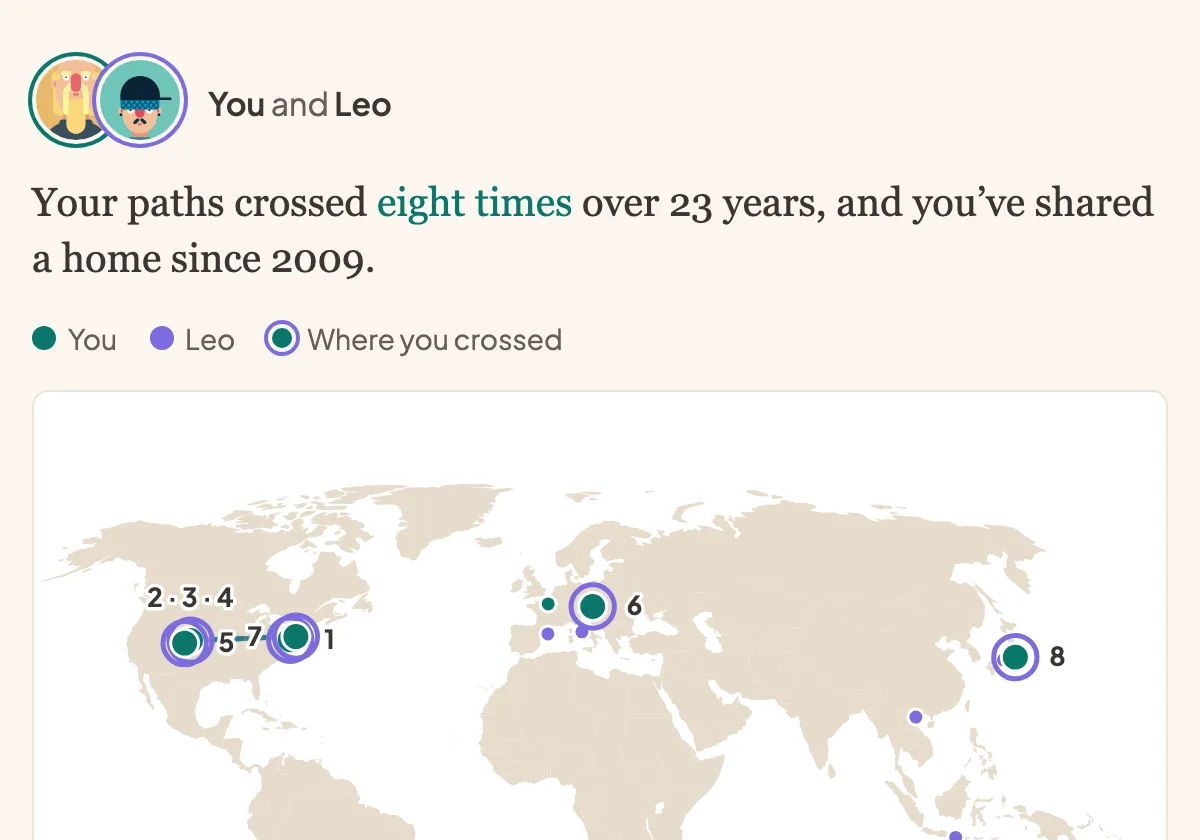


Build out from your life's chapters.
Start with elementary school, the places you've lived or your first job. A few answers fill in whole stretches of years, each with what was happening in the world beside it.
See some examples from the Library →
Let the world jog your memory.
Add Library topics from sports, film, music and more, and see what was going on at the time.
Michael Jackson's Musical History
10 events from before your birth are not shown.
Michael Jackson released 'Bad,' his highly anticipated follow-up to 'Thriller.' The album produced five consecutive Billboard Hot 100 number-one singles, a first for any artist, selling over 35 million copies worldwide and further showcasing his evolving artistry.
Michael Jackson embarked on his first solo world tour, the 'Bad World Tour,' which became the highest-grossing tour of the 1980s. The tour played to over 4.4 million fans across 15 countries, solidifying his reputation as an unparalleled live performer.
The 18-minute short film for 'Bad,' directed by Martin Scorsese, premiered. Set in a subway station, the video showcased Jackson's intricate choreography and edgy persona, becoming another iconic visual piece in his career.
'Man in the Mirror,' a powerful anthem with a message of self-reflection and global change, was released as a single. It became his ninth number-one hit on the Billboard Hot 100 and remains one of his most beloved and impactful songs.
The anthology film 'Moonwalker' was released, featuring a collection of Michael Jackson's music videos and a fantastical storyline. It provided a visual showcase for his music and creative vision, further extending his artistic reach beyond traditional albums.
The music video for 'Black or White' premiered simultaneously in 27 countries, watched by an estimated 500 million people. Its groundbreaking morphing technology and message of racial harmony made it a cultural event, though its controversial ending was later edited.
Michael Jackson released 'Dangerous,' an album that blended R&B, new jack swing, and pop. It debuted at number one, sold over 32 million copies worldwide, and featured hits like 'Black or White' and 'Remember the Time,' showcasing his continued innovation.
The 'Dangerous World Tour' commenced, with Michael Jackson donating all profits to his newly established 'Heal the World Foundation.' The tour captivated millions globally and emphasized his commitment to humanitarian causes.
Michael Jackson was honored with the Grammy Legend Award, recognizing his significant and ongoing contributions to music. This special accolade highlighted his unparalleled influence and enduring legacy in the industry.
Child abuse allegations against Michael Jackson first surfaced, leading to a lengthy investigation and immense media scrutiny. This marked a significant turning point in his public image and personal life, despite the case being settled out of court.
The music video for 'Scream,' a duet with his sister Janet Jackson, was released. Directed by Mark Romanek, it became the most expensive music video ever made at the time, known for its futuristic setting and striking visual effects, reflecting their shared frustration with media scrutiny.
Michael Jackson released 'HIStory: Past, Present and Future, Book I,' a double album featuring a greatest hits compilation and a disc of new material. The album served as a powerful personal statement, addressing media scrutiny and his public image, selling over 20 million copies worldwide.
The 'HIStory World Tour' launched, becoming another massive global spectacle. The tour played to millions across five continents, reinforcing Jackson's reputation as a peerless live performer and supporting his latest album.
Michael Jackson released 'Blood on the Dance Floor: HIStory in the Mix,' a remix album featuring five new songs. It became the best-selling remix album of all time, further demonstrating his ability to innovate within the dance and pop genres.
Michael Jackson organized the 'United We Stand: What More Can I Give' benefit concert in Washington D.C., following the September 11 attacks. Featuring numerous stars, the event aimed to raise funds for victims and promote unity, showcasing his continued philanthropic spirit.
Michael Jackson released 'Invincible,' his tenth and final studio album of original material during his lifetime. Despite internal conflicts with his record label, the album debuted at number one in 13 countries and sold over 10 million copies worldwide, featuring hits like 'You Rock My World.'
Michael Jackson was inducted into the Rock and Roll Hall of Fame as a solo artist, having previously been inducted with the Jackson 5. This second induction recognized his unparalleled impact and legendary status as an individual artist.
Michael Jackson released 'Number Ones,' a greatest hits compilation album featuring many of his chart-topping singles. The album was a commercial success, reminding the public of his extensive catalog of hits and enduring legacy.
After a highly publicized trial, Michael Jackson was acquitted on all ten counts of child molestation and conspiracy. The verdict brought an end to a long and tumultuous legal battle that had significantly impacted his career and public image.
Michael Jackson announced 'This Is It,' a planned series of 50 comeback concerts at London's O2 Arena. The announcement generated unprecedented demand for tickets, selling out in record time and signaling his highly anticipated return to the stage.
Michael Jackson tragically passed away at the age of 50 from an overdose of propofol. His sudden death sent shockwaves across the globe, prompting an outpouring of grief and tributes from fans and fellow artists worldwide, marking the end of an iconic era.
The documentary film 'Michael Jackson's This Is It' was released posthumously, compiled from rehearsal footage for his planned London concerts. It offered fans a poignant glimpse into his final creative endeavors and became the highest-grossing concert film of all time.
The album 'Michael' was released, marking the first posthumous collection of unreleased material from Michael Jackson. It featured collaborations with artists like Akon and 50 Cent, sparking both excitement and controversy regarding the authenticity of some tracks.
'Xscape,' the second posthumous album of previously unreleased Michael Jackson material, was released. Featuring contemporary production by Timbaland and Rodney Jerkins, it aimed to modernize his sound for new audiences and achieved commercial success.
A groundbreaking hologram of Michael Jackson performed 'Slave to the Rhythm' at the Billboard Music Awards. This technological feat allowed for a 'live' performance, showcasing his iconic moves and pushing the boundaries of posthumous entertainment.
A compilation album titled 'Scream' was released, featuring a collection of Michael Jackson's most dance-oriented and Halloween-themed tracks. The album included a new mash-up, 'Blood on the Dance Floor X Dangerous,' appealing to fans of his edgier sound.
On what would have been his 60th birthday, the Michael Jackson Diamond Celebration was held in Las Vegas. The event honored his enduring legacy and influence, with fans and celebrities gathering to celebrate his life and contributions to music and culture.
The controversial documentary 'Leaving Neverland' aired, featuring two men alleging sexual abuse by Michael Jackson during their childhoods. The film reignited public debate and significantly impacted public perception and the ongoing discourse surrounding his legacy.
'MJ the Musical,' a Broadway production centered on Michael Jackson's creative process for the 'Dangerous' tour, won four Tony Awards, including Best Actor in a Musical for Myles Frost. The musical brought his story and music to a new theatrical audience.
To mark the 40th anniversary of its original release, 'Thriller 40' was re-released, featuring bonus tracks and unreleased demos. This commemorative edition allowed new generations to discover the iconic album and celebrated its enduring cultural significance.
FIFA World Cup
6 events from before your birth are not shown.
Mexico stepped in to host the 1986 World Cup after Colombia withdrew, becoming the first country to host the tournament twice. The high altitude and heat presented unique challenges for players.
Just minutes after the "Hand of God," Diego Maradona scored an extraordinary solo goal, dribbling past five English players before slotting the ball home. It was later voted the "Goal of the Century."
In the quarter-final against England, Diego Maradona scored a controversial goal using his hand, which he famously attributed to the "Hand of God." This moment became one of the most talked-about incidents in World Cup history.
Argentina, captained by the influential Diego Maradona, defeated West Germany 3-2 in a thrilling final to claim their second World Cup title. Maradona was awarded the Golden Ball as the tournament's best player.
Italy hosted the 14th FIFA World Cup, marking its second time as host. The tournament was characterized by a defensive style of play, leading to a record low average of 2.21 goals per match.
At 38 years old, Roger Milla became a global sensation for Cameroon, scoring four goals and leading his team to the quarter-finals, the furthest an African team had reached at that time. His goal celebrations became iconic.
West Germany defeated Argentina 1-0 in a contentious final, securing their third World Cup trophy. This victory came just months before German reunification, adding symbolic weight to the triumph.
The United States hosted the 1994 FIFA World Cup, marking the first time the tournament was held in a non-traditional football market. It achieved record-breaking attendance, solidifying football's global reach.
Brazil defeated Italy 3-2 in a penalty shootout after a goalless final, securing their record fourth World Cup title. The decisive moment came when Italy's star player Roberto Baggio missed the final penalty.
Italian star Roberto Baggio famously missed the decisive penalty in the 1994 World Cup final shootout against Brazil. His shot sailed over the bar, handing Brazil the trophy and becoming an enduring image of heartbreak.
France hosted the 16th FIFA World Cup, which expanded to 32 teams for the first time. The tournament was a vibrant celebration, culminating in a historic victory for the host nation.
Zinedine Zidane scored two headers in the final against Brazil, leading France to a dominant 3-0 victory and their first-ever World Cup title. His performance cemented his status as a global icon.
Hours before the 1998 World Cup final, Brazilian star Ronaldo suffered a convulsive fit, leading to his initial exclusion from the lineup. He was controversially reinstated but played poorly, sparking widespread speculation.
The 2002 FIFA World Cup was uniquely co-hosted by South Korea and Japan, marking the first time the tournament was held in Asia and the first time it was shared between two countries.
German goalkeeper Oliver Kahn became the first and only goalkeeper to win the Golden Ball award for the best player at a FIFA World Cup. This recognition came despite Germany's 2-0 defeat to Brazil in the final.
Brazilian striker Ronaldo, after his 1998 final mystery, made a spectacular comeback, scoring eight goals, including two in the final against Germany, to lead Brazil to their record fifth World Cup title.
Germany hosted the 18th FIFA World Cup, its first as a reunified nation. The tournament was praised for its festive atmosphere, efficient organization, and high attendance, drawing global attention.
Italy defeated France 5-3 in a penalty shootout after the final ended 1-1, securing their fourth World Cup title. The match was overshadowed by Zinedine Zidane's red card incident.
In the 2006 World Cup final, French captain Zinedine Zidane was controversially sent off for headbutting Italian defender Marco Materazzi in extra time. It was Zidane's last professional match.
South Africa made history by hosting the 2010 FIFA World Cup, the first time the tournament was held on the African continent. The event was a significant cultural milestone, showcasing African heritage.
The vuvuzela, a long plastic horn, became synonymous with the 2010 World Cup in South Africa. Its distinctive, buzzing sound generated both excitement and controversy among fans and broadcasters worldwide.
Spain defeated the Netherlands 1-0 in extra time, with Andrés Iniesta scoring the winning goal, to claim their first-ever World Cup title. Their "tiki-taka" possession-based style of play dominated the tournament.
Brazil hosted the FIFA World Cup for the second time, 64 years after its first. The tournament was marked by high-scoring matches and passionate support from the host nation, despite some pre-tournament protests.
The 2014 World Cup in Brazil marked the first time goal-line technology (GLT) was used in the tournament. It was successfully deployed to confirm a goal in the match between France and Honduras, reducing refereeing errors.
Uruguayan striker Luis Suárez generated significant controversy when he bit Italian defender Giorgio Chiellini during a group stage match. Suárez received a nine-match international ban and a four-month ban from all football activities.
In one of the most astonishing results in World Cup history, Germany inflicted a humiliating 7-1 defeat on host nation Brazil in the semi-final. This match, dubbed the "Mineirazo," shattered Brazilian hopes and records.
Germany defeated Argentina 1-0 in extra time with a goal from Mario Götze to win their fourth World Cup title. This victory marked the first time a European nation won the World Cup in the Americas.
Russia hosted the 21st FIFA World Cup, marking the first time the tournament was held in Eastern Europe. The event was praised for its organization and fan experience, despite geopolitical tensions.
The Video Assistant Referee (VAR) system was officially introduced at the 2018 World Cup, marking a significant technological shift in football refereeing. It was used to review key decisions, aiming for greater accuracy.
France defeated Croatia 4-2 in a thrilling final to secure their second FIFA World Cup title. The match featured six goals, including an own goal and a VAR-awarded penalty, making it a memorable spectacle.
19-year-old Kylian Mbappé scored in the final against Croatia, becoming the second teenager after Pelé to score in a World Cup final. His electrifying performances earned him the Best Young Player award.
Qatar hosted the 22nd FIFA World Cup, the first to be held in the Middle East and the first to be played in the Northern Hemisphere's winter due to the region's intense summer heat.
The 2022 World Cup in Qatar faced significant controversy regarding human rights issues, treatment of migrant workers, and the environmental impact of building new stadiums. FIFA's decision to award the host nation was widely criticized.
Argentina defeated France 4-2 in a penalty shootout after a thrilling 3-3 draw in the final, securing their third World Cup title. The match is widely regarded as one of the greatest finals in World Cup history.
In his fifth and final World Cup appearance, Lionel Messi led Argentina to victory, scoring two goals in the final and converting in the penalty shootout. This triumph cemented his legacy as one of football's greatest players.
MCU release order
The film that launched the Marvel Cinematic Universe, introducing Robert Downey Jr. as Tony Stark. This marked the beginning of Phase I, 'The Avengers Assemble'.
Edward Norton starred as Bruce Banner in this second MCU film, further expanding Phase I and establishing the presence of the Hulk within the shared universe.
Tony Stark faces new threats and government pressure in this sequel, continuing to build the foundation of Phase I with new character introductions.
Chris Hemsworth debuted as the God of Thunder, introducing the cosmic side of the MCU and further developing Phase I's ensemble cast.
Chris Evans' Steve Rogers was introduced as Captain America in this World War II-era film, completing the main hero lineup for Phase I's culmination.
The first major crossover event, uniting Iron Man, Captain America, Thor, Hulk, Black Widow, and Hawkeye. This film concluded Phase I with a spectacular team-up.
Tony Stark grapples with PTSD and new enemies in this film, which kicked off Phase II of the MCU, 'A New Threat Emerges'.
Thor battles the Dark Elves to save the Nine Realms in this Phase II installment, delving deeper into Asgardian lore.
Captain America uncovers a conspiracy within S.H.I.E.L.D., a pivotal Phase II film that reshaped the MCU's political landscape.
This quirky space adventure introduced a new team of heroes and expanded the cosmic scope of Phase II, proving the MCU's versatility.
The Avengers face an artificial intelligence threat in this major Phase II event, further developing team dynamics and global stakes.
Paul Rudd's Scott Lang debuted as Ant-Man, bringing a new scale of heroism to the conclusion of Phase II.
The Avengers are divided over government oversight in this film, which launched Phase III, 'Cosmic Conflicts and Civil Wars', and introduced Spider-Man and Black Panther.
Benedict Cumberbatch's Stephen Strange entered the MCU, introducing magic and the multiverse concept in this visually stunning Phase III film.
The Guardians explore Peter Quill's parentage in this colorful Phase III sequel, continuing their cosmic adventures.
Tom Holland's Spider-Man received his first solo MCU film in Phase III, navigating high school life and superhero responsibilities.
Thor and Hulk team up to save Asgard in this critically acclaimed Phase III film, praised for its humor and vibrant aesthetic.
This groundbreaking Phase III film introduced the technologically advanced nation of Wakanda and its king, T'Challa, becoming a cultural phenomenon.
The first part of the epic two-part finale for Phase III, where all the MCU heroes united against Thanos in a desperate battle for the universe.
Scott Lang teams up with Hope van Dyne as the Wasp in this Phase III sequel, exploring the Quantum Realm.
Brie Larson debuted as Captain Marvel in this 90s-set Phase III film, revealing her origins and cosmic powers.
The culmination of over a decade of storytelling, this Phase III finale brought together all the heroes to reverse Thanos' actions.
Peter Parker deals with the aftermath of Endgame and a new threat while on a school trip in this film, concluding Phase III and the 'Infinity Saga'.
The first Disney+ series to launch Phase IV, 'Multiverse of Madness', exploring Wanda Maximoff's grief and powers in a unique sitcom style.
This Disney+ series followed Sam Wilson and Bucky Barnes as they grappled with Captain America's legacy in Phase IV.
Tom Hiddleston's Loki returned in this Disney+ series, exploring alternate timelines and introducing key multiverse concepts for Phase IV.
Natasha Romanoff's long-awaited solo film served as a prequel, exploring her past and family before the events of Infinity War, released during Phase IV.
Simu Liu debuted as Shang-Chi in this martial arts-infused Phase IV film, introducing new heroes and a mystical side to the MCU.
This Phase IV film introduced a new team of immortal beings who have secretly watched over humanity for millennia.
Clint Barton teamed up with new archer Kate Bishop in this festive Disney+ series set during Christmas in New York, part of Phase IV.
Peter Parker's identity crisis led to a multiversal event in this highly anticipated Phase IV film, bringing together past Spider-Man iterations.
Oscar Isaac starred as Marc Spector/Steven Grant in this mysterious Disney+ series, introducing the complex hero Moon Knight to Phase IV.
Doctor Strange ventured deep into the multiverse alongside Wanda Maximoff in this reality-bending Phase IV film.
This Disney+ series introduced Kamala Khan, a Pakistani-American teenager and Captain Marvel superfan who gains powers, further expanding Phase IV's roster.
Thor reunited with Jane Foster, now wielding Mjolnir as Mighty Thor, to face Gorr the God Butcher in this Phase IV cosmic adventure.
Jennifer Walters navigated her new life as a 6-foot-7 green superhero lawyer in this comedic Disney+ series, a key part of Phase IV.
The nation of Wakanda mourned its king and fought to protect its future in this poignant Phase IV film, introducing Namor and Ironheart.
James Bond films
14 events from before your birth are not shown.
Directed by John Glen, this film introduced Timothy Dalton as James Bond, bringing a darker, more serious portrayal. Bond faced arms dealer Brad Whitaker and General Georgi Koskov, utilizing a gadget-filled Aston Martin V8 Vantage. It was a successful debut for Dalton.
Directed by John Glen, Timothy Dalton's second Bond film saw him go rogue to avenge a friend, battling drug lord Franz Sanchez. The film featured a more brutal tone and a spectacular tanker truck chase. It achieved moderate box office results.
Directed by Martin Campbell, 'GoldenEye' revitalized the franchise, introducing Pierce Brosnan as James Bond. Bond confronted rogue agent Alec Trevelyan (006) and Xenia Onatopp, utilizing a BMW Z3 and a laser watch. It was a massive critical and commercial success.
Directed by Roger Spottiswoode, Pierce Brosnan's Bond raced against media mogul Elliot Carver, who sought to ignite a war. Bond famously controlled a BMW 750iL using his Ericsson mobile phone. The film was a significant box office success.
Directed by Michael Apted, Pierce Brosnan's Bond protected heiress Elektra King from the terrorist Renard. Q's boat chase on the Thames and X-ray glasses were notable. The film performed well at the box office.
Directed by Lee Tamahori, Pierce Brosnan's final Bond film saw him face Gustav Graves and Miranda Frost. It featured an 'invisible' Aston Martin Vanquish and a dramatic ice palace sequence. The film was a commercial success, marking the 40th anniversary of the franchise.
Directed by Martin Campbell, 'Casino Royale' rebooted the series with Daniel Craig as a grittier, less experienced James Bond. Bond confronts Le Chiffre in a high-stakes poker game, with an Aston Martin DBS as his vehicle. Critically acclaimed and a major box office hit, it redefined the character for a new generation.
Directed by Marc Forster, Daniel Craig's second outing as Bond saw him seek revenge against Dominic Greene and the mysterious Quantum organization. The film featured thrilling car chases and intense action sequences. It was a commercial success.
Directed by Sam Mendes, Daniel Craig's Bond faced the vengeful cyberterrorist Raoul Silva. The film marked the return of the classic Aston Martin DB5 and featured Adele's Oscar-winning theme song. It became the first Bond film to gross over $1 billion worldwide and earned widespread critical acclaim.
Directed by Sam Mendes, Daniel Craig's Bond uncovered the sinister organization SPECTRE, led by Ernst Stavro Blofeld (Christoph Waltz). Bond drove an Aston Martin DB10 and used an Omega Seamaster watch with an explosive. It was a significant box office success.
Directed by Cary Joji Fukunaga, this film marked Daniel Craig's emotional final performance as James Bond, who confronts the villain Lyutsifer Safin. The Aston Martin DB5, equipped with machine guns, made a return. Despite pandemic delays, it was a major box office success and received positive reviews.
The New York Knicks
15 events from before your birth are not shown.
Patrick Ewing made his highly anticipated NBA debut for the Knicks against the Philadelphia 76ers. He scored 18 points and grabbed 6 rebounds, immediately showcasing his potential as a dominant force.
Rick Pitino was named head coach, bringing an up-tempo, full-court press style of play. He helped develop the young Knicks roster, leading them to their first playoff appearance in four years in his first full season.
The Knicks traded for power forward Charles Oakley from the Chicago Bulls. Oakley became a vital enforcer and rebounder, forming a formidable frontcourt alongside Patrick Ewing and embodying the physical style of the Knicks in the 1990s.
Pat Riley, known for his 'Showtime' Lakers, took over as head coach of the Knicks. He instilled a tough, defensive-minded culture, transforming the team into a perennial contender in the Eastern Conference.
The Knicks defeated the 'Bad Boy' Detroit Pistons in a grueling five-game first-round playoff series. This victory signaled the Knicks' emergence as a physical force in the East and a legitimate contender.
The Knicks faced Michael Jordan's Chicago Bulls in a highly anticipated Eastern Conference Finals. Despite holding home-court advantage, the Knicks ultimately lost the physical seven-game series, falling short of the NBA Finals.
The Knicks, led by Patrick Ewing and Coach Pat Riley, reached the NBA Finals for the first time since 1973. They pushed the Houston Rockets to a dramatic Game 7 but ultimately lost the championship series 4-3.
Pat Riley resigned as head coach of the Knicks, famously faxing his resignation. He subsequently joined the Miami Heat, sparking a fierce rivalry between the two franchises for years to come.
Assistant coach Jeff Van Gundy took over as head coach after Pat Riley's departure. Van Gundy continued the team's defensive identity, leading them to several successful playoff runs, including an NBA Finals appearance.
The Knicks signed shooting guard Allan Houston as a free agent. Houston became a key offensive weapon and clutch performer, playing a crucial role in the team's late 1990s playoff runs.
During Game 5 of the Eastern Conference Semifinals against the Miami Heat, a bench-clearing brawl erupted. Several key Knicks players were suspended, costing them the series and intensifying the rivalry.
In a significant trade, the Knicks acquired Latrell Sprewell from the Golden State Warriors. Sprewell quickly became a vital scoring threat and a key component of the Knicks' unexpected run to the NBA Finals in the lockout-shortened 1999 season.
The Knicks made an improbable run to the NBA Finals as an 8th seed, defeating the top-seeded Heat and Pacers. Despite Patrick Ewing's injury, they reached the Finals, ultimately losing to the San Antonio Spurs in five games.
After 15 seasons, franchise icon Patrick Ewing was traded to the Seattle SuperSonics as part of a four-team deal. His departure marked the end of an era and a significant turning point for the franchise.
Guard Allan Houston signed a six-year, $100 million contract extension with the Knicks. This highly scrutinized deal later became known for its significant impact on the team's salary cap flexibility during a period of struggle.
Hall of Famer Isiah Thomas was hired as the President of Basketball Operations for the Knicks. His tenure was marked by controversial trades, coaching changes, and a prolonged period of on-court struggles for the franchise.
New York City native Stephon Marbury was acquired by the Knicks in a trade with the Phoenix Suns. His arrival brought a star point guard to the team amidst high expectations from the fanbase.
Veteran coach Larry Brown, known for his success with multiple teams, was hired by the Knicks with hopes of turning around the struggling franchise. His tenure, however, proved to be brief and largely unsuccessful.
Donnie Walsh was hired as the Knicks' President of Basketball Operations, replacing Isiah Thomas. Walsh was tasked with rebuilding the struggling franchise and clearing salary cap space for future free-agent acquisitions.
The Knicks signed All-Star power forward Amar'e Stoudemire as a free agent. Stoudemire's arrival marked a turning point after years of struggle, bringing renewed excitement and a legitimate star to the Garden.
In a blockbuster trade, the Knicks acquired superstar forward Carmelo Anthony from the Denver Nuggets. This move created a dynamic duo with Amar'e Stoudemire and elevated the Knicks' status as a contender.
Jeremy Lin, an undrafted point guard, emerged from the bench to lead the Knicks on an improbable winning streak, capturing global attention. His electrifying play became known as "Linsanity," providing a much-needed spark for the franchise.
Led by Carmelo Anthony, the Knicks finished the 2012-13 season with a 54-28 record, winning their first Atlantic Division title since 1994. They reached the Eastern Conference Semifinals before losing to the Indiana Pacers.
Led by Carmelo Anthony, the Knicks finished the regular season with 54 wins, their best record in 13 years, and won the Atlantic Division. They defeated the Boston Celtics in the first round before losing to the Indiana Pacers in the Eastern Conference Semifinals.
Legendary coach Phil Jackson, a former Knicks player, was hired as the President of Basketball Operations. He was tasked with bringing his championship pedigree to the front office, though his tenure proved challenging.
The Knicks drafted Latvian forward Kristaps Porziņģis with the fourth overall pick in the 2015 NBA Draft. Despite initial fan skepticism, Porziņģis quickly became a fan favorite and a promising young star for the franchise.
Leon Rose, a prominent player agent, was hired as the President of Basketball Operations, replacing Steve Mills. Rose began a significant restructuring of the front office and coaching staff, aiming to usher in a new era of stability.
The Knicks hired Tom Thibodeau as their new head coach, known for his defensive schemes and demanding coaching style. Under Thibodeau, the team quickly improved, making a return to the playoffs.
After years of rebuilding, the Knicks made a surprising return to the playoffs as the 4th seed in the Eastern Conference, led by All-Star Julius Randle and Coach Tom Thibodeau. They lost to the Atlanta Hawks in the first round, but the season marked a significant step forward.
The Knicks, with Jalen Brunson emerging as a star, finished as the 5th seed and defeated the Cleveland Cavaliers in the first round of the playoffs. Their run ended in the Eastern Conference Semifinals, where they lost to the Miami Heat in six games.
Despite significant injuries, the Knicks, led by Jalen Brunson, secured the 2nd seed in the Eastern Conference. They defeated the Philadelphia 76ers in a thrilling first-round series before falling to the Indiana Pacers in a hard-fought seven-game Eastern Conference Semifinals.
During the 2024 offseason, the New York Knicks made significant roster moves by acquiring All-Stars Karl-Anthony Towns from the Minnesota Timberwolves and Mikal Bridges from the Brooklyn Nets, bolstering their lineup for the upcoming season.
The New York Knicks advanced to the Eastern Conference Finals in the 2025 NBA Playoffs, their first appearance since 2000, where they ultimately lost to the Indiana Pacers in six games.
After five seasons with the team, Tom Thibodeau was fired as the head coach of the New York Knicks.
The New York Knicks announced the hiring of Mike Brown as their new head coach.
The New York Knicks won the inaugural 2025 NBA Cup, defeating the San Antonio Spurs in the championship round.
The New York Knicks advanced to the NBA Finals for the first time since 1999, after winning the Eastern Conference Finals in the 2026 playoffs.
The New York Knicks defeated the San Antonio Spurs 4-1 in the 2026 NBA Finals, securing their third championship in franchise history and their first since 1973. The series ran from June 3 to June 13, 2026.
Following the New York Knicks' victory in the 2026 NBA Finals, point guard Jalen Brunson was unanimously named the Bill Russell NBA Finals Most Valuable Player. He led the team with a series-high 45 points in the decisive Game 5.
Hip-Hop genre evolution
5 events from before your birth are not shown.
This album was the first rap album to reach #1 on the Billboard 200 chart, showcasing hip-hop's crossover potential and breaking new ground for white artists in the genre.
The first hip-hop album to go platinum, featuring the groundbreaking collaboration "Walk This Way" with Aerosmith. This fusion of rock and rap cemented hip-hop's mainstream appeal and crossover success.
Highly influential for its sophisticated lyrical delivery, complex rhyme schemes, and innovative sampling techniques. This album elevated the art of MCing and production in hip-hop.
Critically acclaimed for its politically charged lyrics, militant imagery, and dense, revolutionary sound. This album pushed the boundaries of conscious hip-hop and social commentary.
A seminal album for gangsta rap, it vividly captured the harsh realities of inner-city life in Los Angeles. The album sparked controversy and profoundly influenced a generation of West Coast artists.
A landmark for alternative hip-hop, known for its eclectic samples, positive messages, and whimsical storytelling. It challenged the growing dominance of gangsta rap and expanded the genre's thematic scope.
Co-founded by Dr. Dre and Suge Knight, Death Row Records became the dominant force in West Coast hip-hop, releasing iconic G-funk albums and shaping the sound of the 1990s.
This album defined the G-funk sound, solidifying West Coast hip-hop's commercial and cultural dominance. It also launched the career of Snoop Dogg, making a massive impact on the genre.
A raw, gritty, and innovative album that revitalized East Coast hip-hop. It was known for its distinctive sound, martial arts themes, and collective strength, influencing countless groups.
Universally hailed as a masterpiece of lyrical prowess and storytelling, "Illmatic" is considered one of the greatest and most influential hip-hop albums of all time, a cornerstone of East Coast rap.
A critically acclaimed debut that established The Notorious B.I.G. as a lyrical titan, showcasing vivid storytelling and a blend of street narratives with commercial appeal, defining East Coast sound.
A deeply personal and introspective album that showcased 2Pac's vulnerability and poetic lyricism. It solidified his status as a complex and influential artist, moving beyond traditional gangsta rap themes.
Co-founded by Jay-Z, Damon Dash, and Kareem Burke, Roc-A-Fella became a dominant East Coast label, launching Jay-Z's empire and shaping the sound of mainstream hip-hop for years.
A double album that became one of the best-selling hip-hop albums of all time. It represented the peak of 2Pac's commercial success and the mainstream dominance of West Coast gangsta rap.
A groundbreaking album that masterfully blended hip-hop, R&B, and neo-soul, earning critical acclaim and multiple Grammy Awards, including Album of the Year. It influenced countless artists across genres.
Eminem's major-label debut, introducing his controversial alter-ego and dark humor to a mass audience. It achieved massive commercial success and critical attention, signaling a new era for mainstream hip-hop.
A monumental commercial and cultural phenomenon, this album broke sales records and solidified Eminem's status as a global superstar. It sparked widespread debate about censorship and artistic expression, cementing hip-hop's mainstream power.
An experimental and critically acclaimed album that pushed the boundaries of Southern hip-hop. It showcased OutKast's unique blend of funk, soul, and psychedelic influences, proving the South's creative vitality.
Released on 9/11, this album marked a critical and commercial peak for Jay-Z, featuring soulful production from Kanye West and Just Blaze. It cemented his lyrical legacy and influenced a generation of producers.
A massive commercial success that brought 50 Cent's street-hardened persona and catchy hooks to the forefront. It dominated the charts and significantly influenced mainstream hip-hop's sound and aesthetic.
Kanye West's debut, known for its soulful samples, conscious lyrics, and innovative production, shifted the sound of mainstream hip-hop. It launched a new era of artistic ambition and lyrical introspection.
A commercial juggernaut that solidified Lil Wayne's status as one of the most prolific and influential rappers of his generation. It showcased his unique flow and lyrical dexterity, achieving massive sales.
A highly influential and divisive album that embraced Auto-Tune and explored themes of loss and vulnerability. It paved the way for melodic rap and trap's emotional expression, shifting hip-hop's sonic landscape.
A critically acclaimed concept album that tells a cohesive narrative of growing up in Compton. It is praised for its storytelling, lyrical depth, and revival of West Coast conscious rap, earning widespread accolades.
A sprawling, ambitious, and politically charged album that incorporated jazz, funk, and spoken word. It earned widespread critical acclaim and became a cultural touchstone for its complex themes and musicality.
Notable for its unconventional release and continuous updates via streaming services, this album pushed the boundaries of album distribution in the digital age. It showcased a fluid, evolving artistic process.
A commercial and critical success that blended trap, psychedelic, and experimental sounds, creating a unique sonic landscape. It cemented Travis Scott's status as a superstar and influenced modern trap production.
- Curated
- We pick each topic by hand and add new ones over time.
- Your choice
- Add a whole topic, or just the events you remember.
- Free to use
- Adding a topic is free, and doesn't count as a use.